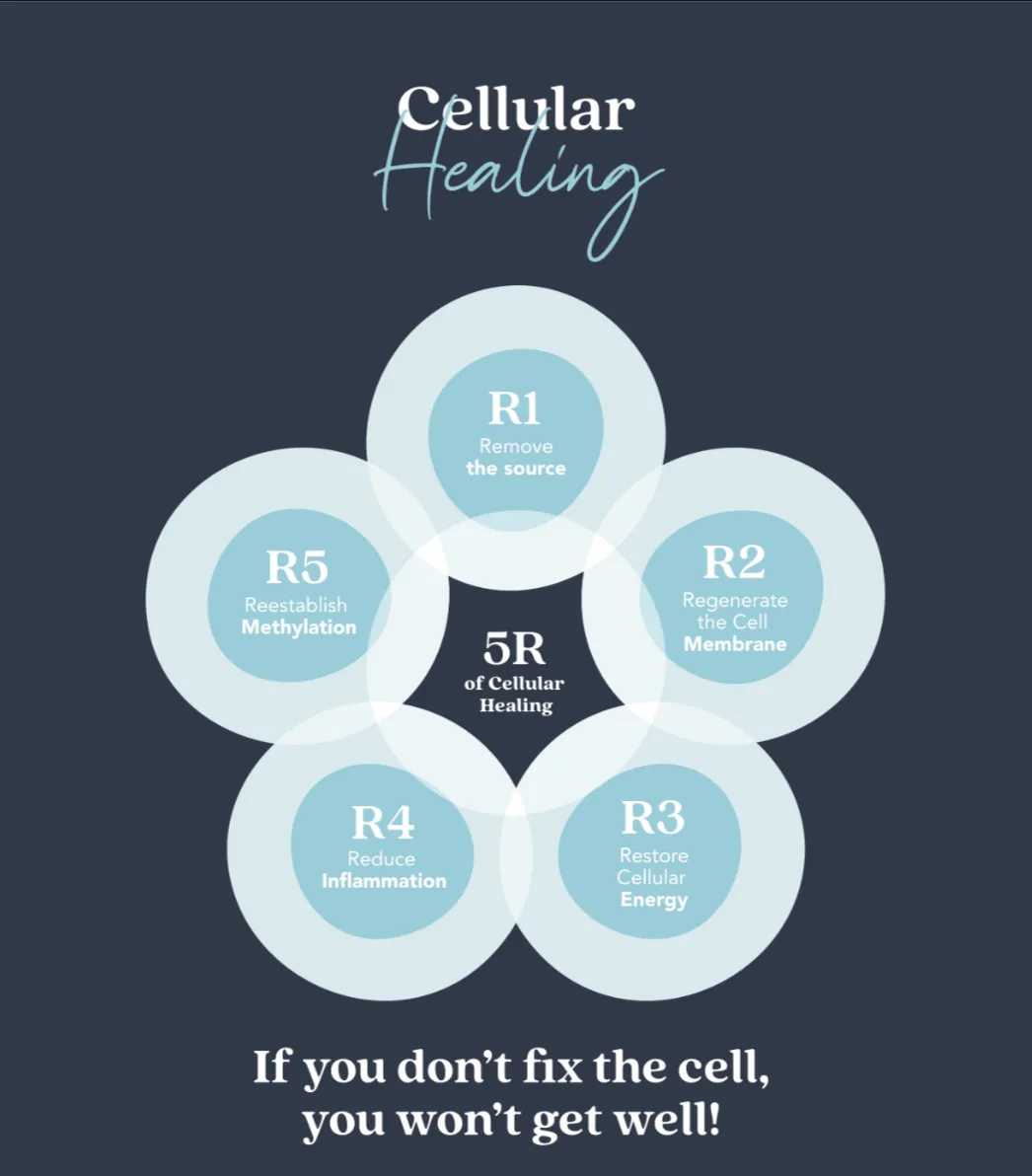
The 5 R’s of Cellular Healing: A Root-Cause Roadmap to Restore Health from the Inside Out
If you’ve been living with Hashimoto’s, stubborn weight resistance, hormone imbalance, or a level of fatigue that sleep never seems to touch, you’re not imagining how hard this has been. Many women I work with arrive after years of trying to do everything “right”—clean eating, removing gluten, taking thyroid medication, meditating, exercising carefully—yet still feeling disconnected from their bodies.
This is where the 5 R’s of Cellular Healing offers a different lens.
Because healing doesn’t begin with your symptoms.
It begins with your cells.
Your cells are not passive. They are living, responsive systems responsible for hormone production, detoxification, immune signaling, inflammation control, and energy creation. When cellular function is compromised, no amount of surface-level intervention can fully restore balance. The thyroid struggles, hormones feel erratic, metabolism slows, and the nervous system stays on high alert.
The 5 R’s of Cellular Healing is a root-cause framework designed to gently restore the cellular environment so your body can return to the state it was always designed for: regulated, resilient, and capable of healing.
This is not a quick fix. It’s a roadmap.
Why Symptoms Aren’t the Starting Point
One of the most important reframes I offer clients is this:
Symptoms are not failures. They are signals.
Fatigue is a signal.
Weight resistance is a signal.
Hormone chaos is a signal.
They’re messages from cells that are overwhelmed, inflamed, under-fueled, or blocked from doing their jobs efficiently. When we chase symptoms without addressing cellular conditions, progress feels temporary—or nonexistent.
The 5 R’s of Cellular Healing shifts the focus from symptom suppression to system restoration.
The 5 R’s of Cellular Healing
1. Remove the Interference
Your cells are constantly communicating—sending signals, receiving nutrients, producing energy, and coordinating immune responses. But interference disrupts that communication.
Interference can include:
Environmental toxins (heavy metals, mold, pesticides)
Endocrine-disrupting chemicals in food and personal care products
Chronic psychological stress
Hidden infections or gut dysbiosis
Blood sugar instability
When interference is present, hormone receptors become less responsive, mitochondria struggle to produce energy, detox pathways slow, and inflammation becomes a baseline state.
What this can feel like:
Brain fog, anxiety that doesn’t match your circumstances, weight that won’t shift, labs that look “normal” while you feel anything but.
Removing interference is not about perfection or detox extremes. It’s about identifying what is burdening your cells and reducing the load in a safe, supported way—often guided by functional testing and a personalized approach.
2. Restore Cellular Energy
Every healing process in the body requires energy. Without it, even the best protocol stalls.
Your mitochondria—often called the cell’s power plants—produce ATP, the energy currency that fuels everything from thyroid hormone conversion to liver detoxification to muscle repair.
When mitochondrial function is impaired, the entire system slows.
Common signs of low cellular energy include:
Waking exhausted despite adequate sleep
Needing caffeine just to function
Afternoon crashes
Feeling wired at night
Exercise intolerance
Restoring cellular energy may involve nutrient repletion, blood sugar stabilization, oxidative stress reduction, and pacing the nervous system so the body feels safe enough to generate energy again.
This is often one of the most overlooked foundations of the 5 R’s of Cellular Healing, yet one of the most transformative.
3. Reduce Cellular Inflammation
Inflammation is not inherently bad—it’s a protective response. But when inflammation becomes chronic, cells lose their ability to repair and communicate efficiently.
At the cellular level, inflammation:
Damages cell membranes
Disrupts hormone receptor signaling
Triggers autoimmune activity
Impairs mitochondrial output
For women with Hashimoto’s or hormone imbalance, this matters deeply. Inflammation often begins long before lab markers change, driven by gut dysfunction, immune activation, blood sugar swings, toxic burden, or chronic stress.
This may show up as:
Elevated antibodies, joint pain, skin flares, bloating, swelling, or a sense that your body is constantly “on edge.”
Reducing inflammation within the 5 R’s of Cellular Healing means calming the internal environment so repair can occur—through nourishment, gut support, nervous system regulation, and targeted anti-inflammatory strategies.
4. Reactivate Cellular Pathways
Your cells are equipped with complex detoxification and repair systems—methylation pathways, antioxidant systems, and phase 1–3 detox processes that neutralize and eliminate waste.
When these pathways are sluggish or overwhelmed, toxins and hormones recirculate instead of exiting the body. The result is often estrogen dominance, chemical sensitivity, histamine issues, or feeling worse when attempting aggressive detoxes.
This can feel like:
PMS, heavy cycles, breast tenderness, headaches, weight retention, or intolerance to supplements and protocols that “should” help.
Reactivation is not about forcing detox. It’s about opening drainage pathways gently—supporting the liver, lymph, gut, and kidneys—so cells can offload waste safely and efficiently.
5. Regenerate and Rebuild
Only after interference is reduced, energy is restored, inflammation is lowered, and pathways are open can true regeneration begin.
This is where the body shifts from survival to repair.
New cells are formed.
Hormone rhythms stabilize.
Immune responses calm.
Energy returns gradually but sustainably.
Within the 5 R’s of Cellular Healing, regeneration is not rushed. Cellular turnover takes time, consistency, and safety. Healing happens in layers, not leaps.
What this may feel like:
Clearer thinking, steadier moods, improved cycles, deeper sleep, and a growing sense of trust in your body again.
Why the 5 R’s of Cellular Healing Matter for Thyroid and Hormone Health
The thyroid does not operate in isolation. Neither do your hormones.
They are deeply dependent on cellular energy, detox capacity, inflammatory status, and nervous system regulation. Medication can be lifesaving—and often necessary—but it cannot override cellular dysfunction.
This is why so many women feel stuck even when they’re “doing everything right.”
The 5 R’s of Cellular Healing offers a comprehensive framework that addresses the terrain your thyroid and hormones depend on, rather than asking them to function under impossible conditions.
Supportive Tools, Not Quick Fixes
In my work with clients, supplements and protocols are used thoughtfully—not as cures, but as support.
Supplements don’t replace healing — they support the systems that make healing possible.
Without addressing cellular foundations, even the best tools fall short. With them, the body often begins to respond in ways that finally feel sustainable.
A Grounded Place to Begin
If this feels like a lot, that makes sense. Many women arrive here already exhausted and overwhelmed.
Here’s what matters most:
Your symptoms are not your fault.
Your body is not broken.
Healing is not about doing more—it’s about doing what supports your cells first.
Understanding the 5 R’s of Cellular Healing is not about fixing yourself. It’s about giving your body the conditions it needs to do what it has always been capable of doing.
If you’d like support learning what your body specifically needs, you can explore the educational tools and resources available at https://guennamullet.com/free-resources —no pressure, just support when you’re ready.
Disclaimer: This information is for educational purposes only and is not intended to diagnose, treat, cure, or prevent any disease. Always consult with a qualified healthcare provider before making changes to your health regimen, especially if you have a medical condition or are taking medication. Functional lab testing and protocols should be supervised by a qualified practitioner.
